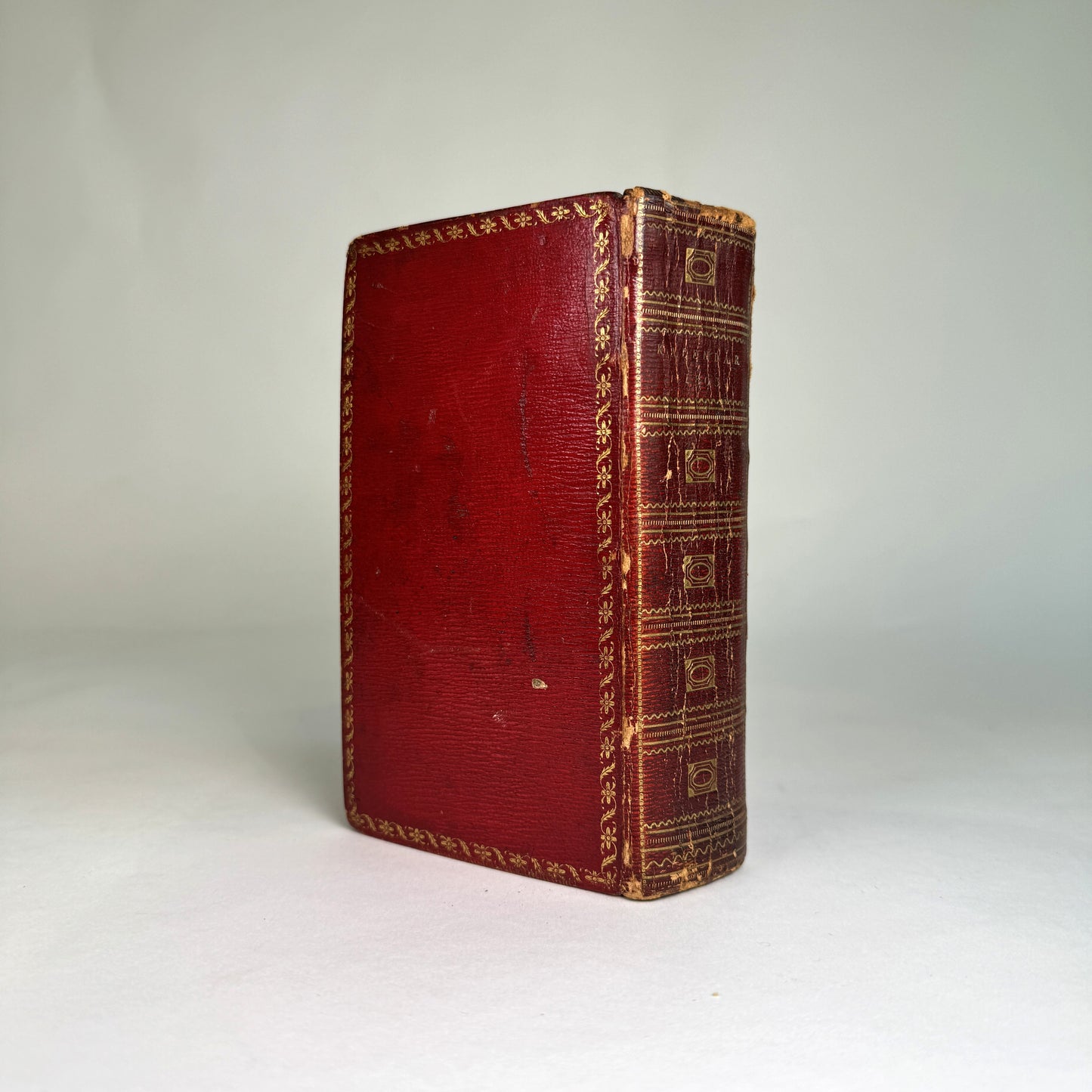
ROYAL KALENDAR. The Royal Kalendar: or, Complete and Correct Annual Register, for England, Scotland, Ireland, and America, for the Year 1803. London: printed for J. Debrett and others, 1803. Bound with RIDER, Cardanus. Rider’s British Merlin: For the Year of Our Lord God 1803. London: printed for the Company of Stationers, 1803.
The 1803 Royal Kalendar and Rider’s British Merlin, in contemporary red morocco, with early military ownership. Small octavo, approx. 6.5 x 4 inches, contemporary red morocco, gilt floral border to boards, gilt spine compartments, marbled endpapers, gilt edges.
A richly informative Georgian pocket reference, combining The Royal Kalendar with Rider’s British Merlin. These annuals were practical working books, giving a ready guide to government, Parliament, the peerage, army and navy lists, public offices, courts, markets, chronology, coinage, heraldry, roads, fairs and useful tables. Rider’s British Merlin also preserves the older almanac tradition, including seasonal and astrological material, with advice on diet, health and temperament, alongside dates of markets and practical information for daily life. Cardanus Rider is often said, though probably wrongly, to have been the pseudonym of Richard Saunders, medical practitioner and astrologer, a member of the circle of William Lilly. Rider’s British Merlin first appeared in 1653 and continued annually into the nineteenth century. The Royal Kalendar was first published in 1767.
This 1803 volume is especially evocative for its moment. Arthur Wellesley appears here before he was the Duke of Wellington, then a rising Major-General in India. In that same year he won the Battle of Assaye during the Second Anglo-Maratha War, the victory which first made his military reputation. Viscount Nelson is listed in the House of Peers, already Britain’s greatest naval hero after Cape St Vincent, the Nile and Copenhagen; in 1803, as war with Napoleonic France resumed, he returned to Mediterranean command, beginning the campaign that would culminate at Trafalgar. Charles Cornwallis appears among the Marquises, a major imperial figure, remembered for Yorktown but later Governor-General of India, Lord Lieutenant of Ireland, and recent negotiator of the Peace of Amiens.
Early ownership inscription “Lieutenant Grosvenor,” likely Thomas Grosvenor, officer in the Coldstream Guards, later General and MP, linking this copy directly to the military and parliamentary world recorded in its pages.
Condition: in its original contemporary red morocco binding, rubbed and worn at extremities, with joints and spine showing age, but attractive and sound. Contents age-toned with occasional marks; early pencil and ink inscriptions to front blanks. A compact, handsome and historically resonant Regency annual.