J. Millan
J. Millan, facing ye Admiralty [London], undated [but 1746].
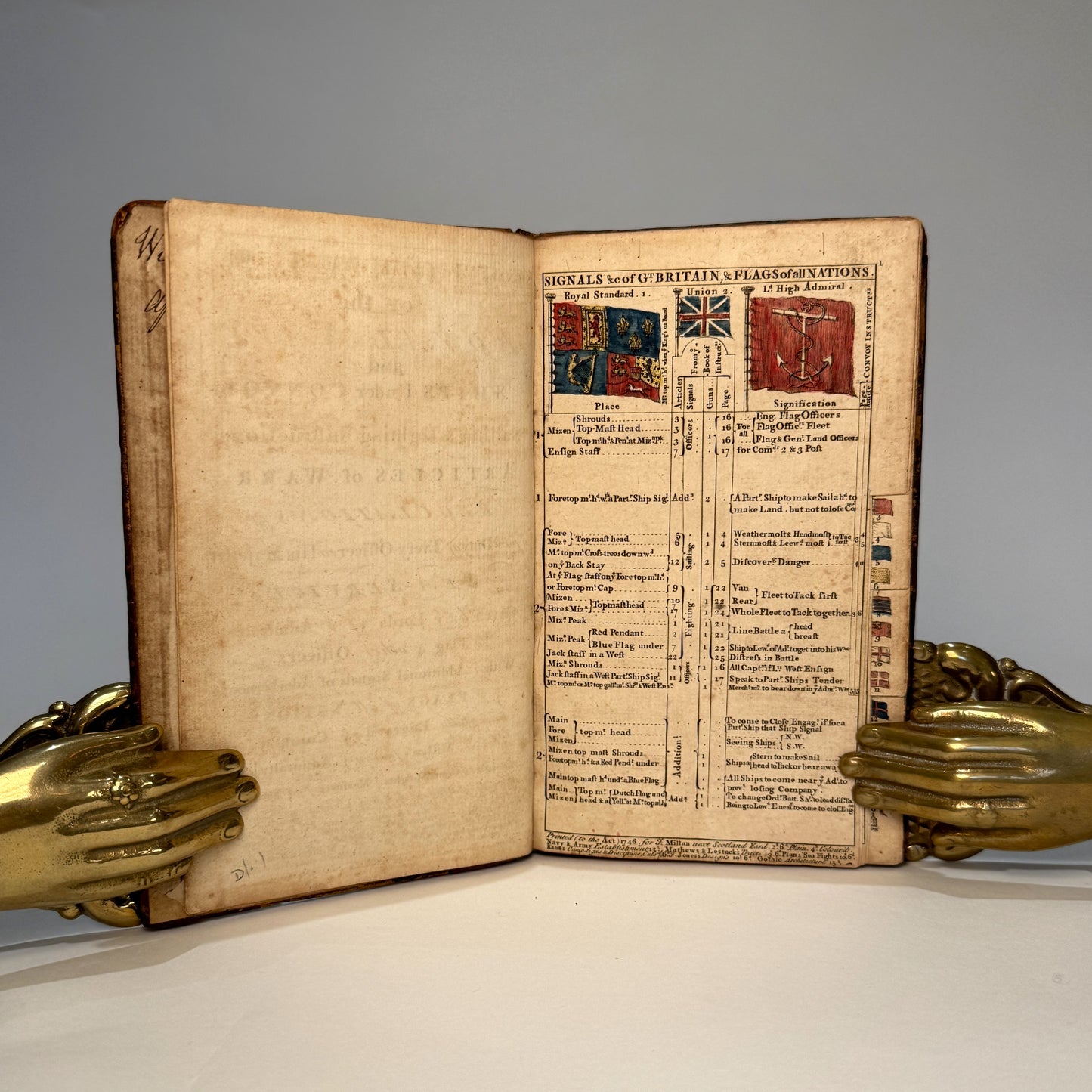
First Edition. A rare survival of the second “Signal Book proper” for use in the Royal Navy, following Greenwood’s 1714 issue. This compact and practical manual, titled in full:
SIGNALS for the ROYAL NAVY and SHIPS Under CONVOY, Sailing & Fighting Instructions, ARTICLES OF WARR, REGULATIONS for Duty of Every Officer in His Majesty’s SEA SERVICE. Given by ye Lords of ye Admiralty, to the Flag & other Officers. With ye Additional Signals of Adm. Vernon &c., & ye FLAGS of all NATIONS.
This small but richly detailed handbook provided the British fleet with standardised sailing and fighting instructions, articles of war, and signalling codes, together with the flags of all nations and the latest signals attributed to Admiral Vernon. It marks a decisive moment in the codification of naval communication during Britain’s emergence as a global maritime power.
12mo (7 x 4 in / 18 x 10 cm). 22 pp., thumb-indexed. All flags finely and vividly hand-coloured throughout, a feature that brings exceptional visual richness to this mid-eighteenth-century naval manual. Bound in contemporary mottled calf, sympathetically preserved with expert repairs to the raised bands, ensuring the integrity of the original spine structure.
This copy bears the armorial bookplate of Sir William Abdy, 6th Baronet (c.1732–1803), and is signed and dated by him “April 2ᵈ 1759” to the front pastedown. Abdy began his seafaring career with the Honourable East India Company in 1750 aboard the True Briton and later the Stafford, before transferring into the Royal Navy, where he commanded H.M.S. Beaver (1761–1766). He was promoted to post captain shortly thereafter.
A handsome and historically resonant example, notable both for its complete suite of hand-coloured signal plates and its distinguished naval provenance. The thumb indexing remains intact, the plates retain strong early pigment, and the text is clean for its age.
A significant rarity - seldom encountered in commerce - representing one of the earliest and most authoritative printed codifications of British naval signals.