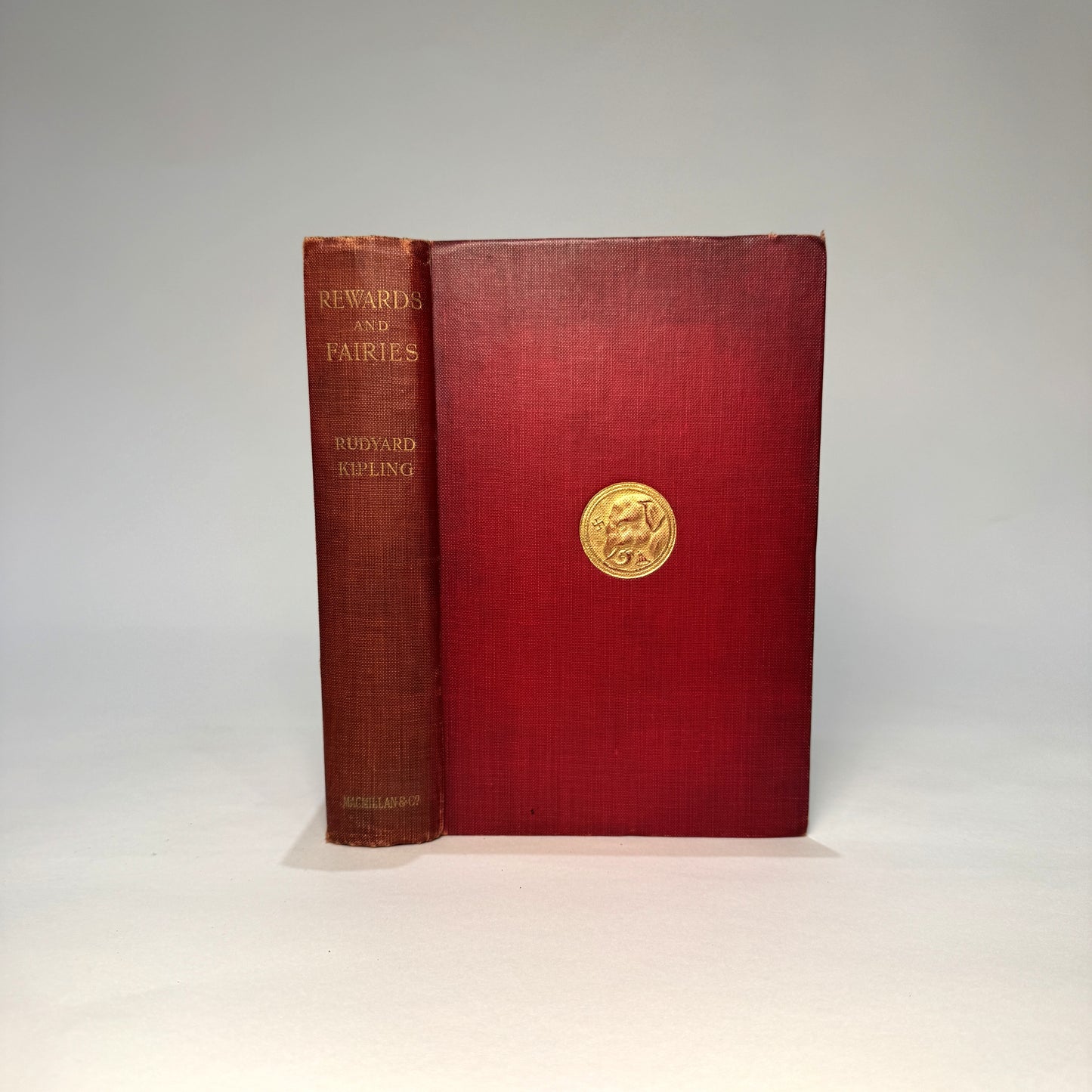
London: Macmillan and Co., Limited, 1910. First Edition of Rewards and Fairies, published at a point when Kipling had already become a literary institution, yet still capable of the unexpected. On the surface it’s a companion to Puck of Pook’s Hill - the same children, the same encounters, the same thin veil between history and enchantment - but it quickly became known for something else entirely: the debut of “If-”, a poem that detached from the book almost immediately and went on to have a cultural life of its own.
In 1910, “If-” appeared without fanfare on page 175, folded quietly into a chapter rather than presented as a separate poem. Its rise was slow and organic, lasting decades before it became the ubiquitous touchstone it is now. Early printings of Rewards and Fairies remain the only place to find it in its first setting, before the anthologies, before Churchill, before public-school walls turned it into a national catechism.
The binding is the publisher’s red cloth with the gilt elephant-and-castle medallion designed for Kipling’s Macmillan titles, a motif already strongly associated with his imperial settings. The spine has settled to a deeper tone, characteristic of the period’s dyes, while the gilt roundel on the board remains bright.
The front pastedown carries a vivid and rather memorable Ex Libris of Wilfrid M. Langdon, its colours still sharp. Endpapers show the usual toning and foxing from storage. The title page is clean, with its red border still crisp and well-defined.
The text is evenly toned throughout, with the printing of “If-” untouched on page 175. The gatherings remain firm, and the book holds itself well.
A first edition rooted firmly in its historical moment: the Edwardian fascination with folklore, the last flourish of Kipling’s imaginative prose, and the quiet debut of the poem that would eventually eclipse almost everything else he wrote.