

Peter Wilson
No. 7 Squadron R.F.C. - Peter Wilson - Air Chief Marshal Lord Portal Association Copy
No. 7 Squadron R.F.C. - Peter Wilson - Air Chief Marshal Lord Portal Association Copy
Couldn't load pickup availability
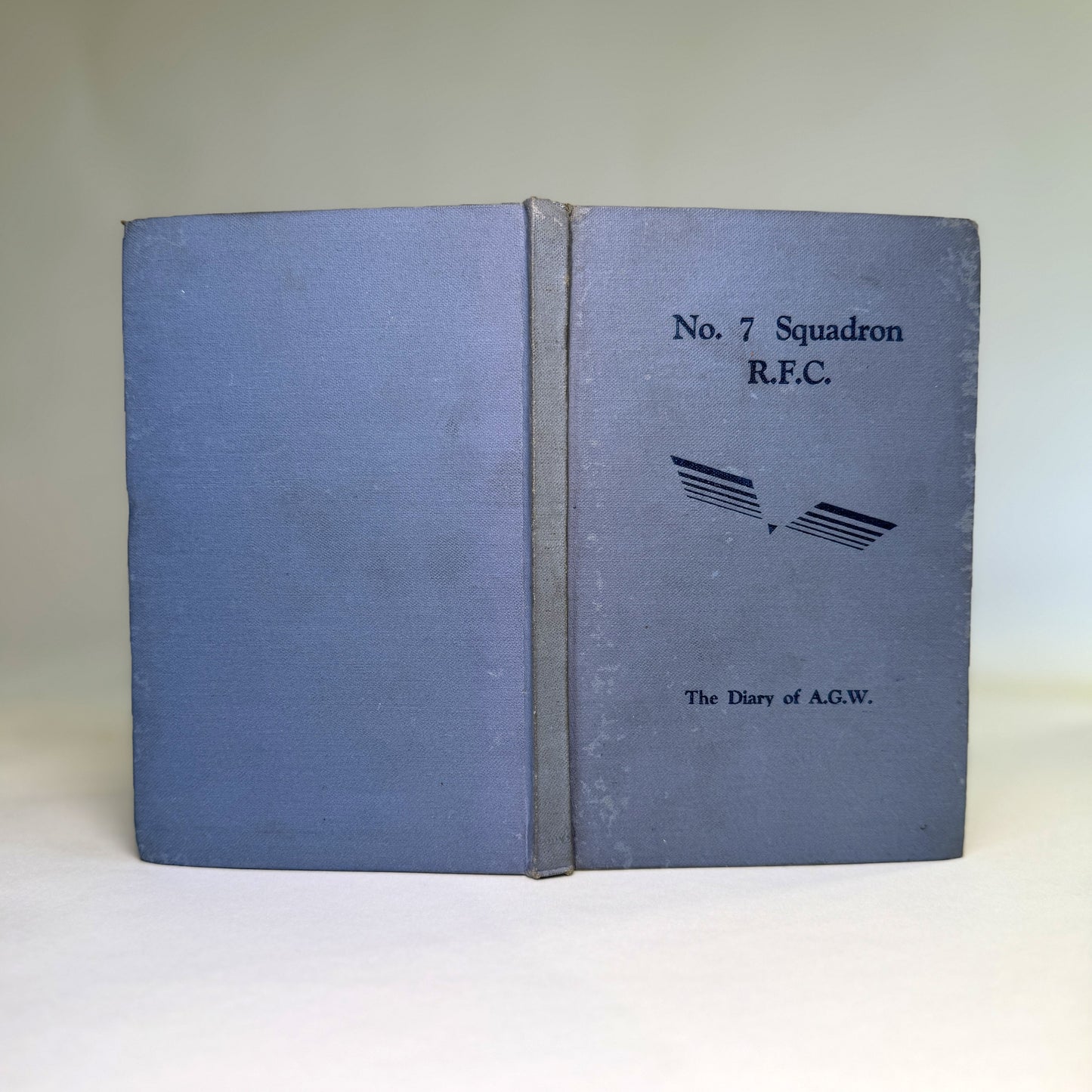
WILSON, Peter. No. 7 Squadron R.F.C.: The Diary of A.G.W. Aylesbury: Hunt, Barnard & Co., privately printed, n.d. [c. post-First World War].
First edition, first impression. A privately printed account of No. 7 Squadron, Royal Flying Corps, in original blue cloth, lettered in dark blue to the upper board. Illustrated with a group photograph of the officers of No. 7 Squadron R.F.C., dated May 1918. From the personal collection of Air Chief Marshal Lord Portal, with his ownership inscription “Portal” to the front free endpaper.
A highly evocative association copy. The diary was written by Peter Wilson, whose personal record forms the basis of the volume. It captures the daily texture of an RFC corps squadron at war: artillery observation, counter-battery work, reconnaissance, contact patrols, wireless telephony, bombing duties, and the mixture of danger, routine, humour and improvisation that defined early military aviation.
The Portal association is especially resonant. Portal’s own military career began in the First World War, first in the Royal Engineers and then in the Royal Flying Corps, where he became a pilot and flight commander. Those early experiences shaped the whole course of his later life, culminating in his position as Chief of the Air Staff during the Second World War.
This privately printed squadron record would have spoken directly to Portal’s memories of early air warfare. It belongs to the same formative world from which Portal emerged: fragile machines, artillery cooperation, observation flights, improvised tactics, and the gradual creation of air power as a serious arm of war. In Portal’s library, Wilson’s diary becomes more than a scarce squadron history. It is a personal bridge between the RFC of 1918 and the RAF high command of 1939-45.
Good condition. Cloth rubbed and marked, spine dulled, corners worn. Inner hinges tender with some exposed binding and age-toning to endpapers, but complete and sound overall.
Share