

[Nelson, Admiral Horatio] Darby, Henry D’Esterre
Nelson’s Execution Order - Captain Darby’s HMS Bellerophon Pocket Book, Naples 1799
Nelson’s Execution Order - Captain Darby’s HMS Bellerophon Pocket Book, Naples 1799
Couldn't load pickup availability
DARBY, Henry D’Esterre. Nelson’s Execution Order - Captain Darby’s HMS Bellerophon Pocket Book, Naples 1799.
A major Nelson discovery, and a rare surviving command notebook from the most controversial period of his career.
At the heart of the volume is the court martial of William White, late boatswain’s mate of HMS Bellerophon, sentenced to death, followed by Nelson’s own memorandum directing that the sentence be carried into execution the following morning. The charge itself is vivid. White was tried “for having in the evening of the 21st of August last, then being confin’d in irons, behaving in a mutinous manner...”; the notebook then records, in substance, that he seized an officer by the collar, threatened that he would “split his head”, and used other mutinous language besides.
The court found that White had fallen under the 22nd Article of War covering striking, offering violence to, or quarrelling with a superior officer in the execution of his office - and sentenced him “to suffer Death by being Hang’d by the neck at the Yard Arm of such ship as the Commander in Chief for the Time being shall think fit...” Nelson’s own implementing memorandum is equally stark: “Whereas Wm White late Boatswain’s Mate of H.M. Ship Bellerophon hath been condemned by the sentence of a Court Martial to suffer Death...”
He then orders that the boats of the squadron be turned out and marines attend the punishment. It is an extraordinary survival: sentence on one page, execution order on the next. For all Nelson’s later reputation for clemency and generosity of spirit, this manuscript shows the other side of command - discipline made public, and mercy suspended in favour of authority.
The pocket book also preserves one of the most moving contrasts in Nelson material: the memorandum headed “Battle of the Nile”, issued from the Foudroyant on 1 August 1799, the first anniversary of his great victory. Nelson writes:
“This being the Anniversary of the Battle of the Nile a Day so glorious to our Country by the noble exertions of British Seamen...”
and, in a line of remarkable humanity,
“that no heart may have cause to be sad on such a Day”
requests that faults committed up to that day be forgiven, and that each man in the squadron receive “one half Pint of Wine” to drink the King’s health. Few manuscripts capture so well the tension between Nelson the celebrant of victory and Nelson the enforcer of discipline.
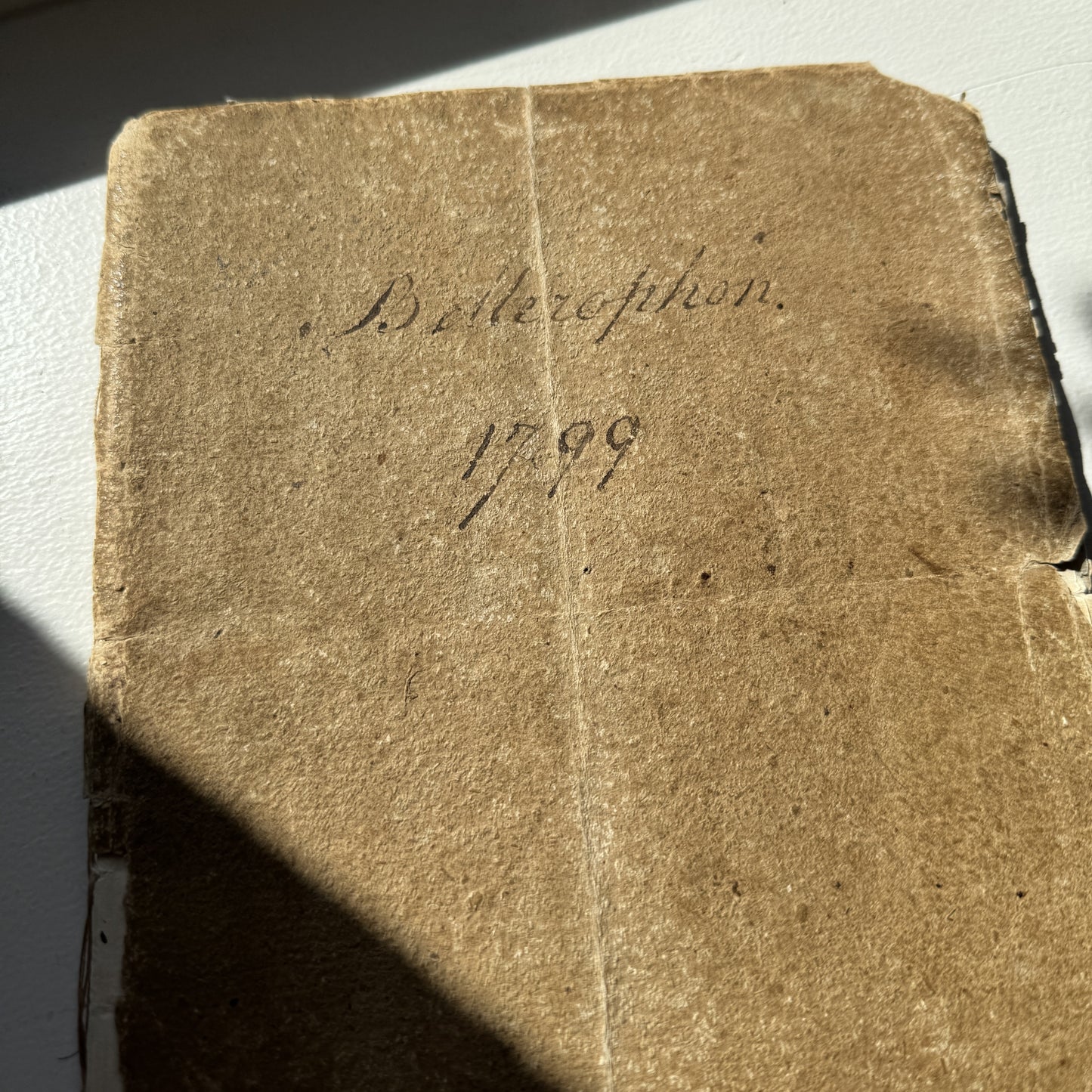
Pocket book of Captain Henry D’Esterre Darby of HMS Bellerophon, kept between April and October 1799, chiefly during June and July 1799 when serving in the Bay of Naples as part of Nelson’s squadron after the Battle of the Nile, recording incoming memoranda and orders principally from Nelson himself, with others by Nelson’s flag captains Thomas Masterman Hardy and Sir Edward Berry, and by Earl St Vincent, Sir John Duckworth, and Sir Robert Calder; the volume kept in a variety of contemporary hands and comprising transcripts of forty-six memoranda and orders issued by or on behalf of Nelson, including thirty-five copied from originals bearing Nelson’s signature, three unsigned, seven issued on his behalf by Hardy, and one by Berry. Original pebble-grain paper wrappers stamped from an earlier use “42 Pound 1702”, upper cover inscribed in ink “Bellerophon / 1799”. Small 4to, 8 1/4 x 6 1/4 in. Bay of Naples and elsewhere, 1799.
Kept for Captain Henry D’Esterre Darby aboard HMS Bellerophon, the pocket book preserves the daily pressure of Nelson’s command in real time. More than a collection of orders, it offers an unfolding sequence of court martial, execution order, Battle of the Nile anniversary order, intelligence instructions, casualty reports, prisoners in irons, and restrictions on letters and communication. Nelson, Hardy, Berry, Darby, the Bellerophon, Naples, punishment, intelligence, censorship, battlefield loss, and the anniversary of the Nile are all present in one surviving working document. This is not simply Nelson in correspondence, but Nelson the commander, seen day by day in the exercise of authority.
The manuscript is of exceptional rarity and importance. Nelson’s 1798-99 Public Order Book is in the British Library, and only two other such Public Order Books survive, thereby placing Darby’s pocket book within an exceptionally small and distinguished group of Nelson command manuscripts. It contains transcripts of forty-six memoranda and orders issued by or on behalf of Nelson, and adds approximately forty new memoranda and orders to the surviving corpus of Nelson’s correspondence. These orders read almost like modern e-mails, with an urgent, practical force that gives a vivid sense of Nelson’s presence at the centre of events.
What makes this pocket book exceptional is its combination of famous names, famous ships, and brutal content. Darby, Nelson, Hardy, and Berry were central actors in the great age of British naval victory. The Bellerophon herself had fought with distinction at the Battle of the Nile, suffering heavily after engaging the vast French flagship L’Orient. She would later serve in the Trafalgar era, while the men represented here remained instrumental to the defining actions of the Napoleonic wars. In 1815 the Bellerophon would win still greater fame as the ship to which Napoleon surrendered after Waterloo.
Beyond the execution order, the book is rich in the day-to-day mechanics of command: intelligence-gathering on the Brest Fleet, casualty reports from fighting ashore in Italy, orders concerning prisoners under irons, restrictions on letters and communication, shore control, victualling, and close supervision of vessels and men. One memorandum stresses the “utmost importance” of obtaining intelligence of the probable destination of the Brest Fleet, directing officers to inspect logs, question masters, and note course, wind, bearings, and distance from land. Elsewhere the notebook preserves reports of battlefield losses on a startling scale, including one entry recording the French “completely defeated” with losses of “11,000 Infantry & 1500 Cavalry”, and another stating that “22,000 men” were said to have been left dead in the field, with “6000” taken prisoner and “300 Officers of Distinction” killed or wounded. It preserves the atmosphere of Naples in 1799 not through hindsight, but through the hurried language of working memoranda.
Physically, the notebook remains exactly what it ought to be - a working shipboard document, made for use rather than display. It has been expertly conserved, with the textblock carefully re-sewn and the vellum-covered boards skilfully re-backed in order to stabilise and secure the volume, while preserving its character as a surviving document of active service. Some wear and signs of handling remain entirely consistent with a notebook carried and consulted aboard ship, and only add to its force as a genuine survival from the quarterdeck rather than a later presentation copy.
An extraordinary manuscript of Nelson’s command: execution, intelligence, punishment, censorship, celebration, and the daily pressure of history, all preserved in the pocket book of the captain of the Bellerophon.
Provenance: Bonhams, London, Nelson and the Royal Navy, 18 October 2005, lot 30.
Cataloguer’s note: The Nelson entries in the present volume have been described here conservatively as copies entered into Darby’s pocket book from originals bearing Nelson’s signature. It should, however, be noted that Nelson’s post-1797 hand, following the loss of his right arm, can be variable, and there is some scope for argument that certain signatures may be in his own hand. In the interests of professional accuracy, we have preferred the more cautious description.
Share