

PORTAL, Lady.
Marchwood Park Guinea Pig Club Album Presented to Lady Portal, 1943
Marchwood Park Guinea Pig Club Album Presented to Lady Portal, 1943
Couldn't load pickup availability
PORTAL, Lady. Marchwood Park Presentation Album - Guinea Pig Club Airmen, 1943.
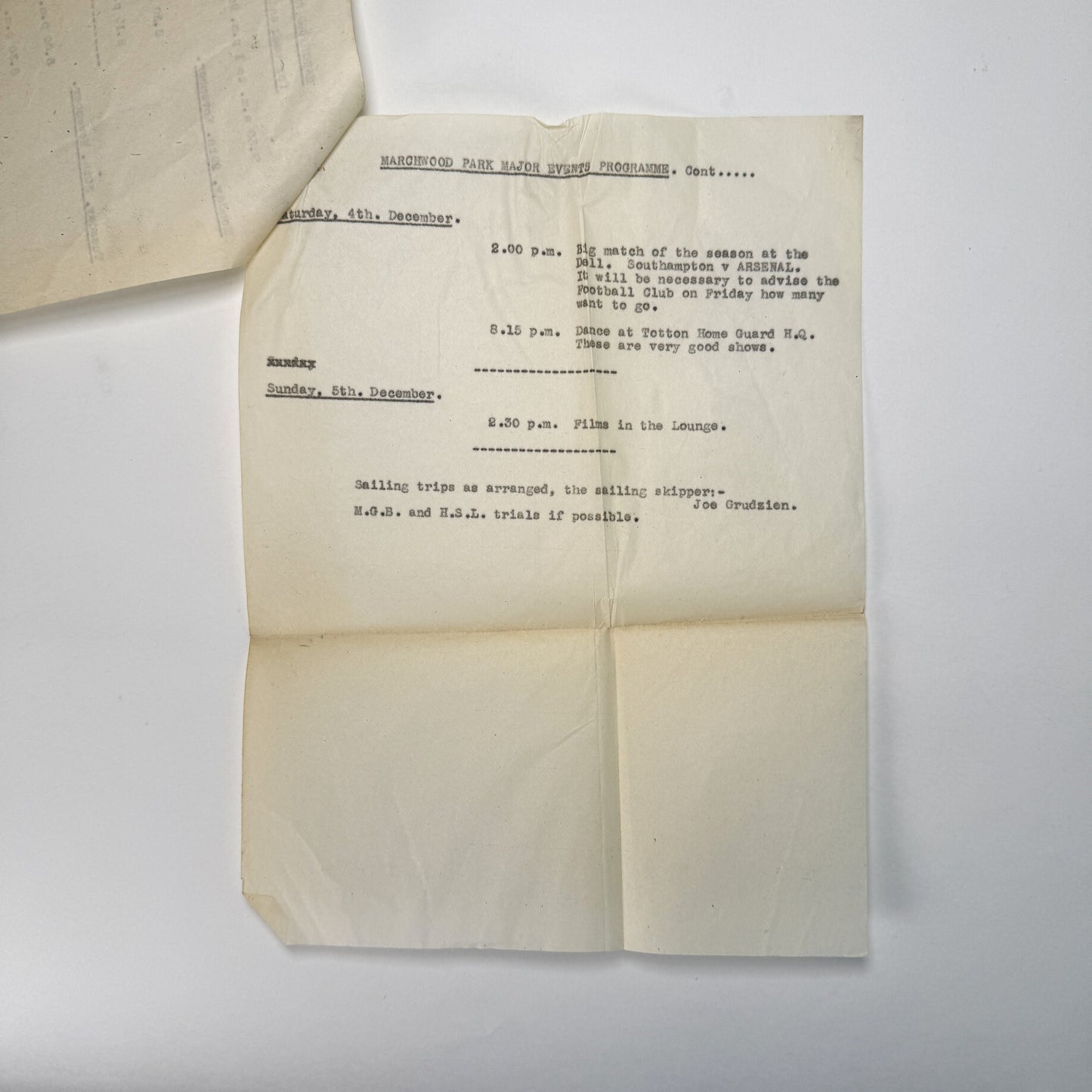
Wartime presentation album given to Lady Portal, wife of Air Chief Marshal Sir Charles Portal, Chief of the Air Staff, as a memento of her visit to Marchwood Park on 29 November 1943. Bound in brown quarter leather with gilt rules and textured boards, containing mounted photographs, manuscript title and explanatory pages, staff list, roll of injured airmen, residents’ signatures, and two loose typed programme sheets for the week ending Sunday 5 December 1943.
This is a remarkable survival from one of the most humane and experimental corners of the air war. Marchwood Park was not a hospital in the ordinary sense. The album explains that it opened on 6 September 1943 as “an experiment in re-habilitation of injured members of aircrews,” created through cooperation between the Air Ministry and the British Power Boat Company. Its purpose was to help badly injured airmen, many of them connected with the Guinea Pig Club, recover not only from wounds but from the shock of returning to life.
The Guinea Pig Club had grown out of Sir Archibald McIndoe’s pioneering plastic surgery work at Queen Victoria Hospital, East Grinstead. Its members were RAF and Allied aircrew who had undergone experimental reconstructive surgery after burns, crashes and disfiguring injuries. The East Grinstead Museum records that between operations the Guinea Pigs convalesced at Dutton Homestall or Marchwood Park in Hampshire. The RAF Benevolent Fund describes the Guinea Pig Club as beginning with badly burned airmen and growing into a unique mutual-support community for men undergoing long, repeated operations and rehabilitation.
The loose Marchwood programme brings that recovery to life with unusual immediacy. The week’s activities are almost cinematic: workshops each morning; football, netball and sailing trials; a lecture in the library; gramophone music; films in the lounge; a grand dance; concerts by troops and local entertainers; a visit to the Anchor Inn at Eastleigh; and a tour of the Power Boat works. This was rehabilitation as McIndoe understood it - not hiding wounded men away, but returning them to companionship, confidence, humour, work and public life. East Grinstead became famous as “the town that didn’t stare,” because local people were encouraged to accept the injured airmen without shrinking from their scars. Marchwood Park appears here as part of that same philosophy.
The human weight of the album lies in its names. Among the airmen listed is Josef Koukal, Czech pilot of 310 Squadron, a Battle of Britain veteran and founder member of the Guinea Pig Club. Koukal was shot down in September 1940, badly burned, underwent numerous operations, and eventually returned to flying - an extraordinary story of survival and defiance. Also present is John Brian Wood Birks, D.F.C., whose East Grinstead record describes serious facial injury and a long course of reconstructive operations after a propeller accident at RAF Cottesmore. Joseph Grudzien, a Canadian air gunner, is another important name: East Grinstead Museum records him as a Marchwood Park figure, injured in a Halifax crash in August 1943. These are not anonymous convalescents; they are pilots, observers, navigators, wireless operators and air gunners from the front line of the air war.
The photographs make the record still more immediate. One mounted image shows Marchwood Park itself; another shows a group of young airmen at the entrance, with a handwritten caption identifying “Dusty” Rhodes, Harold Tunwell, “Wishy,” Brian Birks, Dicky Battrick, Jock Craig, “Mitch,” Jack Reynolds and Jimmy Mc..., several of whom also appear in the album’s roll of injured airmen. The signatures of staff and residents then turn the volume into a collective memorial, written by the very people whose recovery it records.
Lady Portal’s presence is significant. The album is presented to her as “the wife of the C.A.S.” - the wife of the Chief of the Air Staff - and as thanks for her interest in the patients and staff. That places Marchwood Park under the sympathetic notice of the very top of RAF command. The album therefore joins three worlds: the wounded airmen of McIndoe’s Guinea Pig Club, the practical wartime machinery of rehabilitation, and the senior RAF circle of Portal himself.
Condition is very good for a handmade wartime album. The binding is attractive and sound, with light wear to spine, corners and boards. Internally there is age-toning, minor marking, hinge wear and handling, but the mounted photographs, manuscript pages and signatures remain strong. The two loose typed programme sheets are folded, toned and creased with minor edge wear, but they are exceptionally important survivals, giving a daily record of Marchwood’s social and rehabilitative life.
Share