

John Barrow
John Barrow - The First Illustrated English Book on Vietnam - A Voyage to Cochinchina, 1806 - First Edition
John Barrow - The First Illustrated English Book on Vietnam - A Voyage to Cochinchina, 1806 - First Edition
Couldn't load pickup availability
BARROW, JOHN. A Voyage to Cochinchina. First Edition, 1806. The First Illustrated English Work on Vietnam, with Hand-Coloured Aquatints and Folding Maps.
BARROW, John, Sir. A Voyage to Cochinchina, in the Years 1792 and 1793: Containing a General View of the Valuable Productions and the Political Importance of this Flourishing Kingdom; and also of such European Settlements as were Visited on the Voyage: with Sketches of the Manners, Character, and Condition of their Several Inhabitants. To which is Annexed, An Account of a Journey, Made in the Years 1801 and 1802, to the Residence of the Chief of the Booshuana Nation. London: Printed for T. Cadell and W. Davies, in the Strand, 1806.
First edition, first impression. Quarto. Illustrated with 19 hand-coloured aquatint plates after William Alexander and Samuel Daniell, engraved by Thomas Medland, including a folding panoramic view of Rio de Janeiro, together with two folding engraved maps: a hand-coloured plan of the harbour and town of Rio de Janeiro, and a chart of the southern extremity of Africa with the route marked in red. Abbey, Travel 514; Cordier, Sinica 2390-2391; Mendelssohn I, p.89; Tooley 86; Hill 66.
An exceptionally attractive copy of a major early illustrated account of Vietnam, described by Hill as the first illustrated English work on the country. Barrow's narrative arose from the outward voyage of Lord Macartney's embassy to China, during which he travelled by way of Madeira, the Canary Islands, Rio de Janeiro, Tristan da Cunha, the Cape of Good Hope and Batavia before reaching Cochinchina, now southern and central Vietnam.
The book's importance lies equally in its text and its remarkable suite of illustrations. Its hand-coloured aquatints record landscapes, buildings, maritime scenes, natural history and local life encountered across a voyage spanning the Atlantic, Indian Ocean and South China Sea. Among the most striking are the folding panoramic views of the land surrounding the harbour of Rio de Janeiro, the finely detailed plan of the town and harbour, and the richly coloured scenes including a wounded shark beside a fishing canoe and the Calvinist Church at Batavia.
Barrow's account of Cochinchina draws substantially upon the manuscript memoir of Captain Barissy, a French naval officer who had served the King of Cochinchina and had acquired detailed knowledge of the region. At a time when English readers had access to very little reliable visual or descriptive material concerning Vietnam, the publication offered a significant early account of its geography, products, political importance and inhabitants.
The work is also of considerable interest for Brazil and southern Africa. Barrow's description of Rio de Janeiro is accompanied by some of the most appealing images in the volume, including the folding harbour panorama and hand-coloured plan. Annexed to the voyage is an account of an expedition made in 1801 and 1802 to the residence of the chief of the Booshuana nation, now more commonly referred to in relation to the Tswana peoples. This appended section includes the folding chart of southern Africa and further aquatints after Samuel Daniell, extending the book's significance beyond Southeast Asian travel into African exploration and ethnographic history.
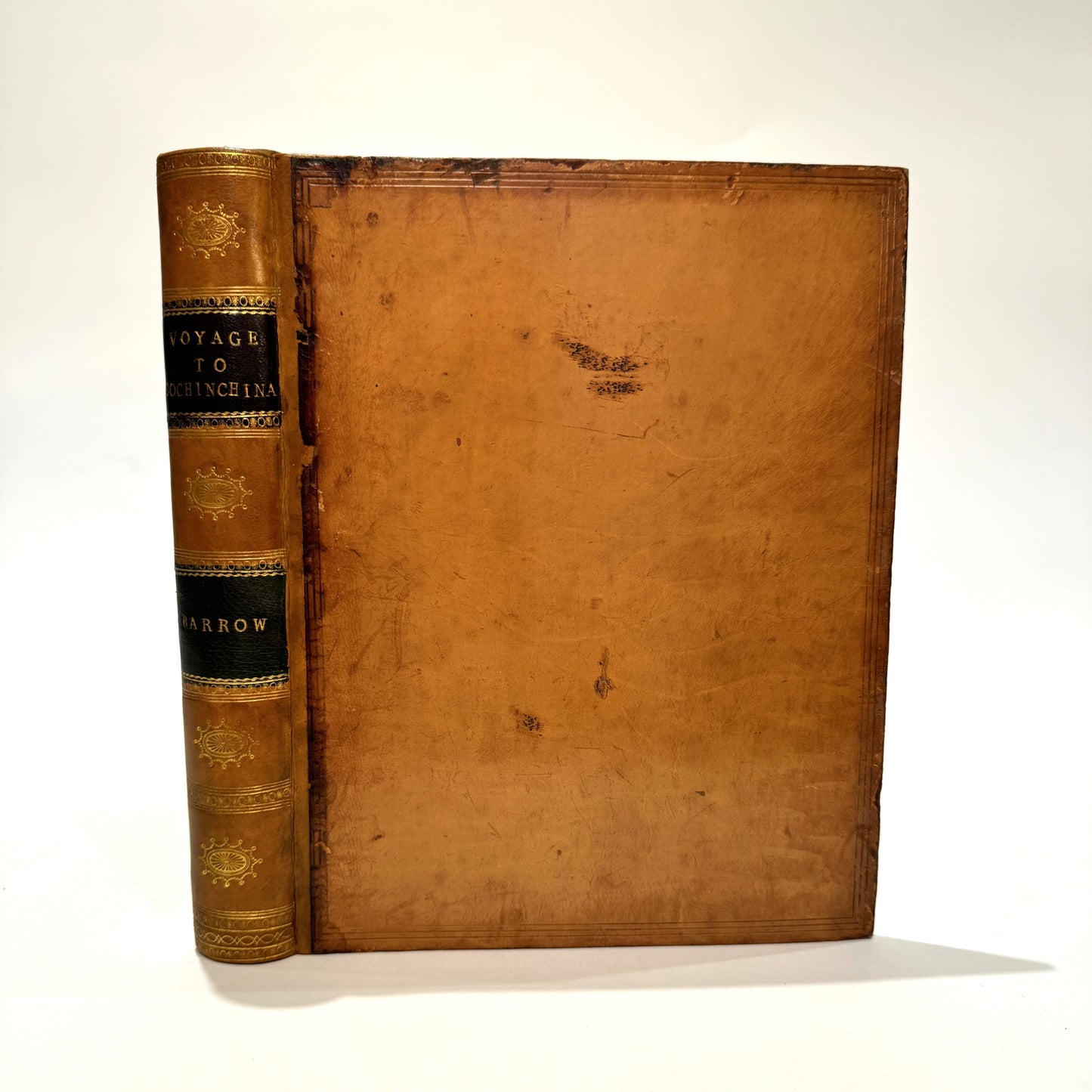
The volume is bound in contemporary calf boards, sympathetically rebacked in matching calf, the spine gilt in compartments with black morocco labels lettered in gilt “Voyage to Cochinchina” and “Barrow.” The boards retain their period gilt-ruled borders and display the mellow patina of a substantial early nineteenth-century travel book.
The binding shows rubbing, scratching and surface wear to the boards, with heavier wear near the joints and upper edges, entirely consistent with age and use. Internally, the title page shows light offsetting from the adjacent folding map and occasional age-related toning and spotting are present. The folding maps and hand-coloured aquatints remain visually impressive, with the colouring retaining considerable freshness.
A highly desirable first edition of one of the earliest and most important English illustrated books concerning Vietnam, further enriched by its fine hand-coloured views of Rio de Janeiro, Batavia and southern Africa. A compelling volume for collections of Southeast Asia, Vietnam, Brazil, African exploration, maritime travel, cartography and colour-plate books.
Share