

COMMISSION FOR THE INVESTIGATION OF SNAKE-POISONING
Indian and Australian Snake-Poisoning - 1874 Calcutta Government Report on Cobra Venom, Early Antidote Trials and Colonial Toxicology
Indian and Australian Snake-Poisoning - 1874 Calcutta Government Report on Cobra Venom, Early Antidote Trials and Colonial Toxicology
Couldn't load pickup availability
INDIA. COMMISSION FOR THE INVESTIGATION OF SNAKE-POISONING. Report on the Effects of Artificial Respiration, Intravenous Injection of Ammonia, and Administration of Various Drugs, &c. in Indian and Australian Snake-Poisoning; and The Physiological, Chemical, and Microscopical Nature of Snake-Poisons.
Calcutta: Printed at the Bengal Secretariat Press, 1874.
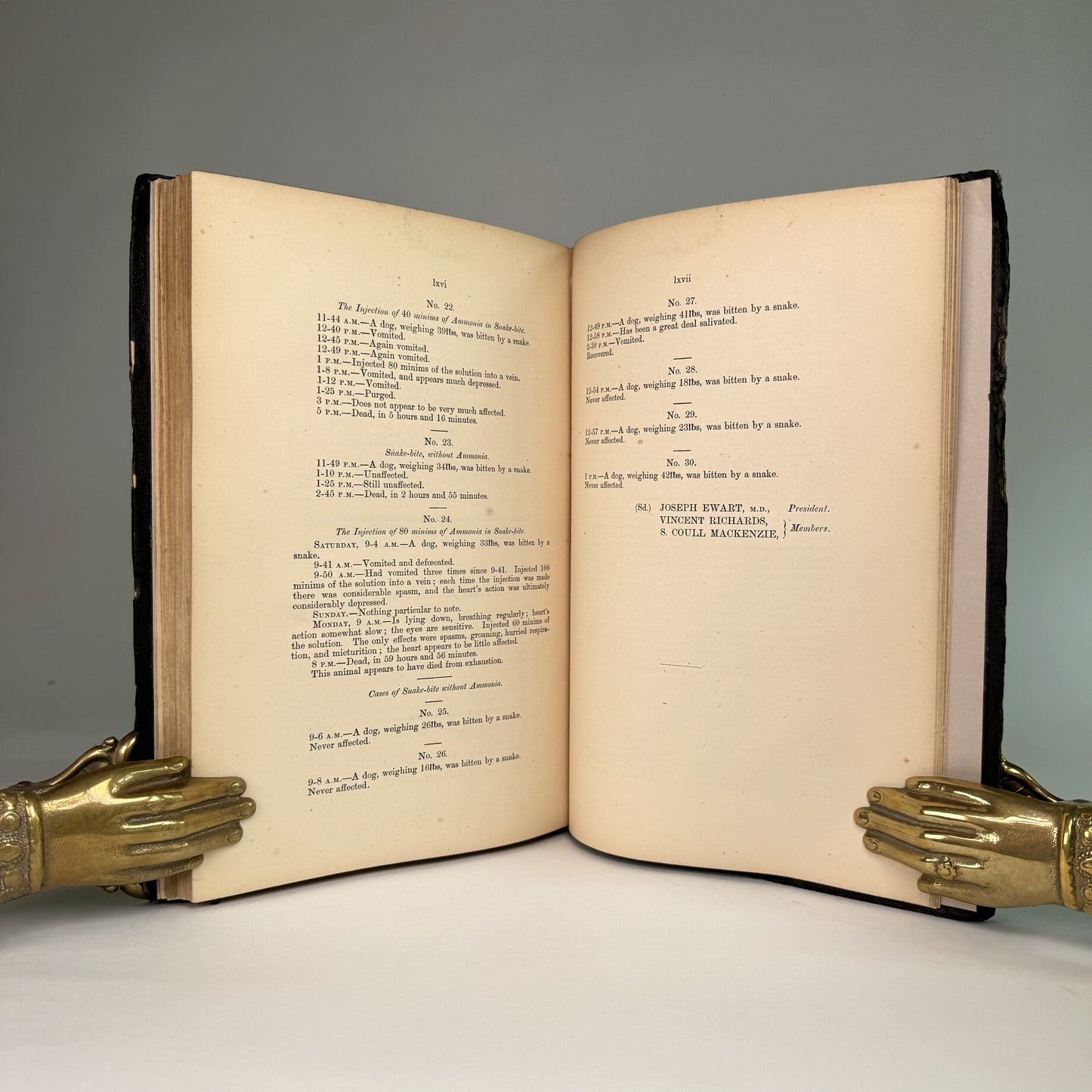
First edition, first impression. Government report, produced by the Commission appointed to investigate the subject. Small quarto. Original brown cloth boards lettered in gilt to the upper cover, rebacked in modern black cloth, retaining the original front board. Title page, 77 pp., lxxiv pp. appendices/index, and four monochrome plates, including microscopic studies of cobra material. Original printed wrapper retained within.
A rare and extraordinary colonial medical report from the early scientific history of snakebite, antivenom research and tropical toxicology. Commissioned in British India, where snakebite was a persistent and deadly rural hazard, the report was undertaken by Joseph Ewart, Vincent Richards and S. Coull Mackenzie, and grew directly out of the great nineteenth-century attempt to understand the action of cobra and other snake venoms before the development of modern antivenom.
The book reads today like a grim but compelling laboratory drama. The Commission tested the principal proposed remedies of the period: artificial respiration, intravenous ammonia, brandy, opium, Epsom salts, nicotine, strychnine and other drugs. The results were largely devastating for fashionable cures. Ammonia, much promoted in the period, is shown here to possess no real antidotal power, while the experiments on respiration, circulation and the heart are recorded in minute detail. There are tables of trials, timed case notes, physiological tracings, and microscopic plates showing the mouth of a cobra and other material connected with venom research.
Its importance lies in the moment it captures. This is pre-antivenom science at full stretch: colonial medicine, emergency treatment, animal experiment, microscopy, toxicology and public health all converging around one lethal question - could snakebite be understood scientifically, and could death be prevented? The answer was still incomplete, but reports such as this helped clear away ineffective treatments and prepared the ground for the later serum era.
The report also stands in direct relation to the work of Sir Joseph Fayrer, whose Thanatophidia of India had appeared in 1872, and to the experiments of Fayrer and Lauder Brunton on cobra venom. Joseph Ewart later published The Poisonous Snakes of India, intended for officials and others living in the Indian Empire, making this Commission report one of the substantial official foundations behind later practical snakebite literature.
Condition: rebacked in modern black cloth, original boards worn, rubbed and chipped at corners and edges, with surface marks and losses. Internal condition generally very good for such a working government report, with scattered foxing, toning, small nicks and minor marks. The title page shows old marginal repair or adhesion marks near the gutter. Plates present. A rare survival, with considerable scientific, medical and colonial historical interest.
A remarkable early government study of venom, antidotes and tropical medicine, printed in Calcutta at the Bengal Secretariat Press in 1874, and an arresting document from the dangerous borderland between field medicine, laboratory science and imperial administration.
Share