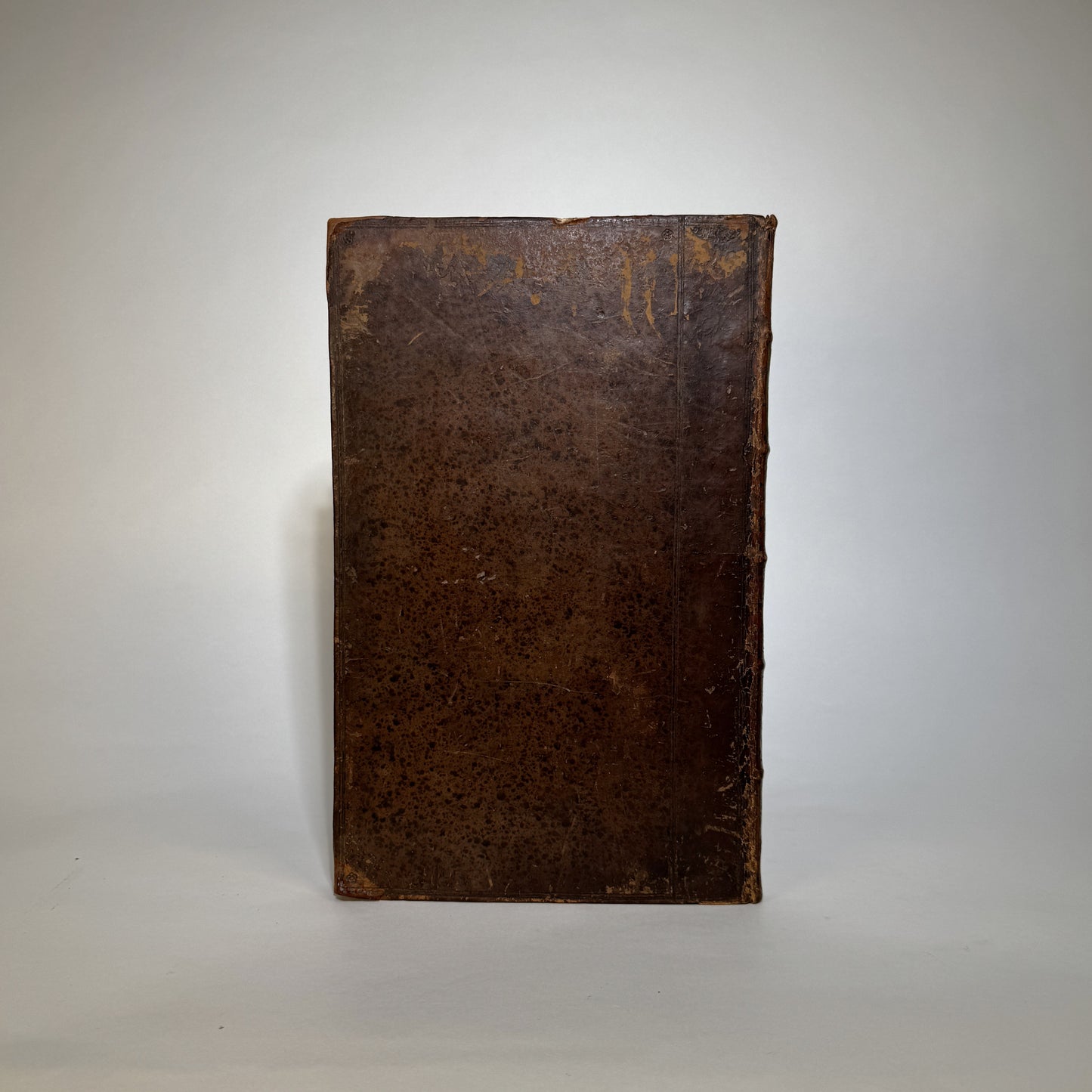
REA, John. Flora: seu, De Florum Cultura. Or, A Complete Florilege, Furnished with all Requisites Belonging to a Florist.
London: printed by T. N. for George Marriott, 1676.
Second impression, corrected, with many additions and several new plates.
Folio. Preserved in its contemporary calf binding, the spine divided by raised bands and decorated in gilt, with a green morocco title label. With the allegorical engraved title, the accompanying poem “The Mind of the Front”, the title page printed in red and black, engraved floral headpieces and geometrical garden plans.
John Rea’s Flora is one of the defining English gardening books of the seventeenth century. Written from more than forty years of practical experience at his celebrated garden at Kinlet, it brought together the cultivation, selection and arrangement of hundreds of flowers, shrubs and fruit trees. Rea was particularly renowned for his tulips and wrote at a moment when newly introduced plants were transforming the English garden.
The work is divided into three books devoted to Flora, Ceres and Pomona. It combines instructions for laying out gardens and nurseries with detailed observations on flowering plants, annuals, biennials and orchard fruits. The engraved plans preserve fashionable formal garden designs, while the headpieces present abundant arrangements of flowers and fruit.
This enlarged 1676 edition substantially updated the original publication of 1665. The volume retains the character of a working seventeenth-century gardening book, with its condition and binding shown in the photographs.
Provenance: Margaret Berry, Lindens, Burnham, Buckinghamshire, ownership inscription on the front endpaper.
The historical importance is well established: Christie’s describes Flora as one of the most important English gardening books of the later seventeenth century, while bibliographer Blanche Henrey regarded it as the period’s leading English gardening treatise.